
How to Choose the Best Personal Injury Lawyer in Cleveland in 2026

The best way to choose a personal injury lawyer in Cleveland is to evaluate candidates the way lawyers and judges evaluate each other: confirm peer-reviewed credentials, check the lawyer's license and disciplinary standing, find out who will personally handle your case, and read the fee agreement carefully before you sign anything. Advertising volume tells you how much a firm spends on marketing. It tells you nothing about how that firm performs when a case is contested.
At Ciano & Goldwasser, we have represented seriously injured Ohioans for more than 25 years, and many of our cases come to us as referrals from other attorneys, judges, and former clients. Those referring lawyers have already run this evaluation on us. You can run it yourself, and it takes less time than most people expect.
Why Your Choice of Lawyer Matters Under Ohio Law
Three features of Ohio law raise the stakes of this decision, especially in serious injury cases.
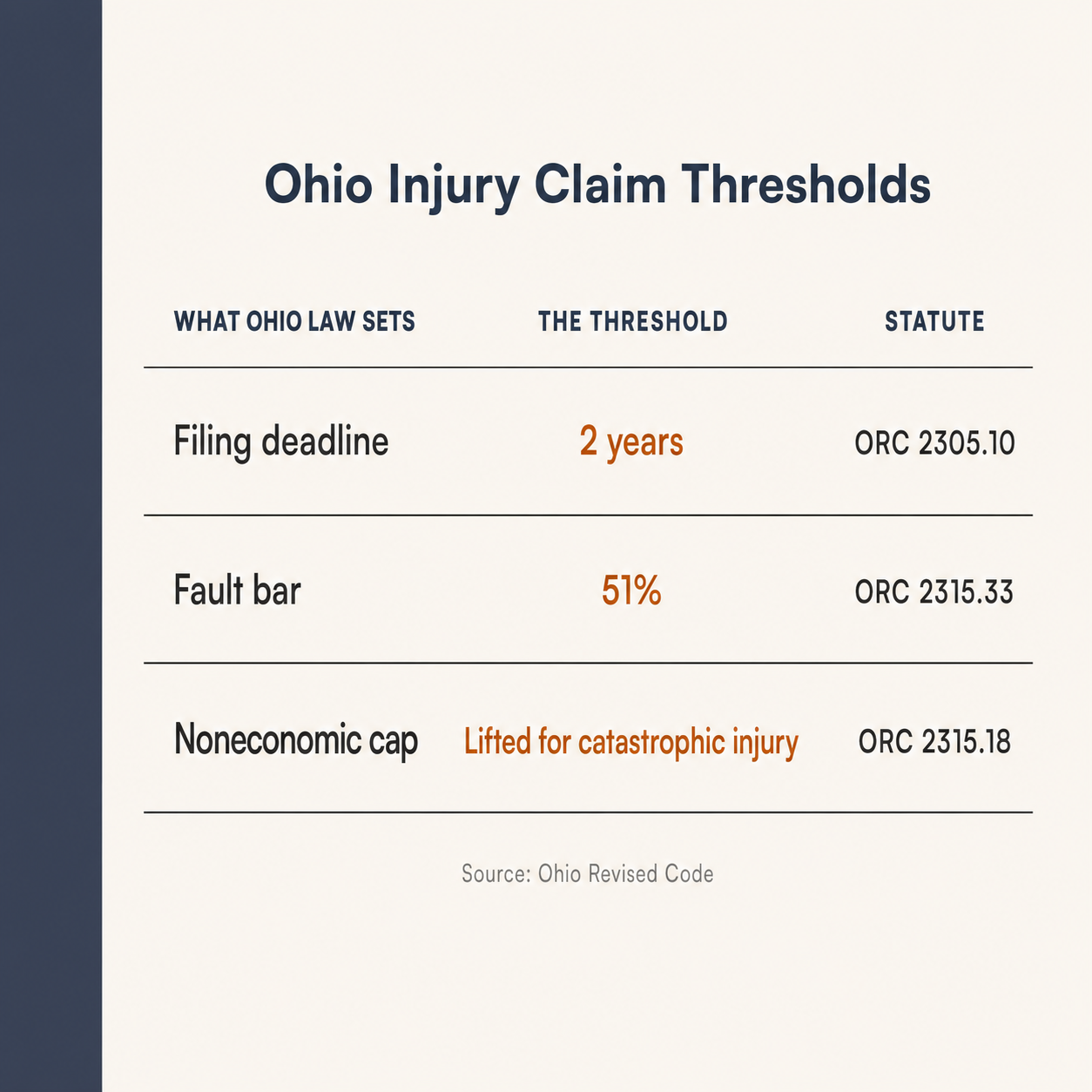
You have limited time. Under ORC § 2305.10, most Ohio personal injury claims must be filed within two years of the date the claim accrues. Wrongful death claims run on their own two-year clock, measured from the date of death under ORC § 2125.02. Limited exceptions exist, such as tolling for minors, but the practical point is the same. Time spent with the wrong firm is time you cannot get back. If you have lost a family member, our wrongful death page explains how these claims differ from standard injury cases.
Fault percentages decide everything. Ohio follows a modified comparative negligence rule under ORC § 2315.33. If you are found 50% or less at fault, your recovery is reduced by your percentage of fault. At 51% or more, you recover nothing. Insurance companies understand this math, which is why disputed-liability cases reward lawyers who investigate thoroughly, preserve evidence early, and can prove their version of events in court.
Damage caps make case classification matter. For most tort actions, ORC § 2315.18 caps noneconomic damages (pain and suffering) at the greater of $250,000 or three times economic damages, up to $350,000 per plaintiff. Economic damages such as medical bills and lost wages are never capped. The cap disappears entirely for catastrophic injuries, including permanent and substantial physical deformity, loss of use of a limb, loss of a bodily organ system, or injuries that permanently prevent independent self-care. Wrongful death claims are also outside the cap. Whether an injury qualifies for a cap exemption can change the value of a case by an enormous margin, which is one reason catastrophic injury cases demand lawyers with specific experience litigating them.
Which Attorney Awards and Ratings Actually Mean Something?
Some legal credentials are earned through independent peer review. Others are advertising products a lawyer can buy. Knowing which is which is the fastest way to cut through the marketing.
You can read the selection methodologies yourself at Best Lawyers, Super Lawyers, and the National Trial Lawyers. When a firm's homepage displays badges, spend two minutes checking which column of this table each badge belongs in.
| Credential | How It Is Earned | What It Tells You |
|---|---|---|
| Best Lawyers in America | Peer review only; lawyers cannot pay to participate. Roughly 5% of U.S. lawyers are recognized. "Lawyer of the Year" goes to one lawyer per practice area per metro region. | Other lawyers would refer their own cases to this attorney. |
| Super Lawyers | Peer nominations plus independent research across 12 indicators, capped at 5% of a state's attorneys. Lawyers cannot nominate themselves. | Sustained peer respect combined with verified results. |
| National Trial Lawyers Top 100 | Invitation-only membership based on peer nomination and third-party research, generally requiring 10+ years of trial practice. | A peer-vetted membership designation, not a literal ranking. |
| Paid directory placements | Purchased. Avvo, Justia, and FindLaw all sell premium or sponsored positions on their own advertising pages. | The lawyer bought visibility. Nothing more. |
How Do You Verify a Lawyer's License and Standing in Ohio?
A lawyer's license and disciplinary history are public records, and both are free to check.
Confirm the license. The Supreme Court of Ohio Attorney Directory lists every registered Ohio attorney by name or registration number, including registration status. The Court itself cautions that directory inclusion alone does not confirm good standing, so check the status field, not just the name.
Check disciplinary history. The Office of Disciplinary Counsel publishes disciplinary decisions and pending cases, and the Board of Professional Conduct maintains an online docket for cases filed since 2015. A clean record here is a baseline requirement, not a selling point.
Do You Need a Lawyer Who Actually Tries Cases?
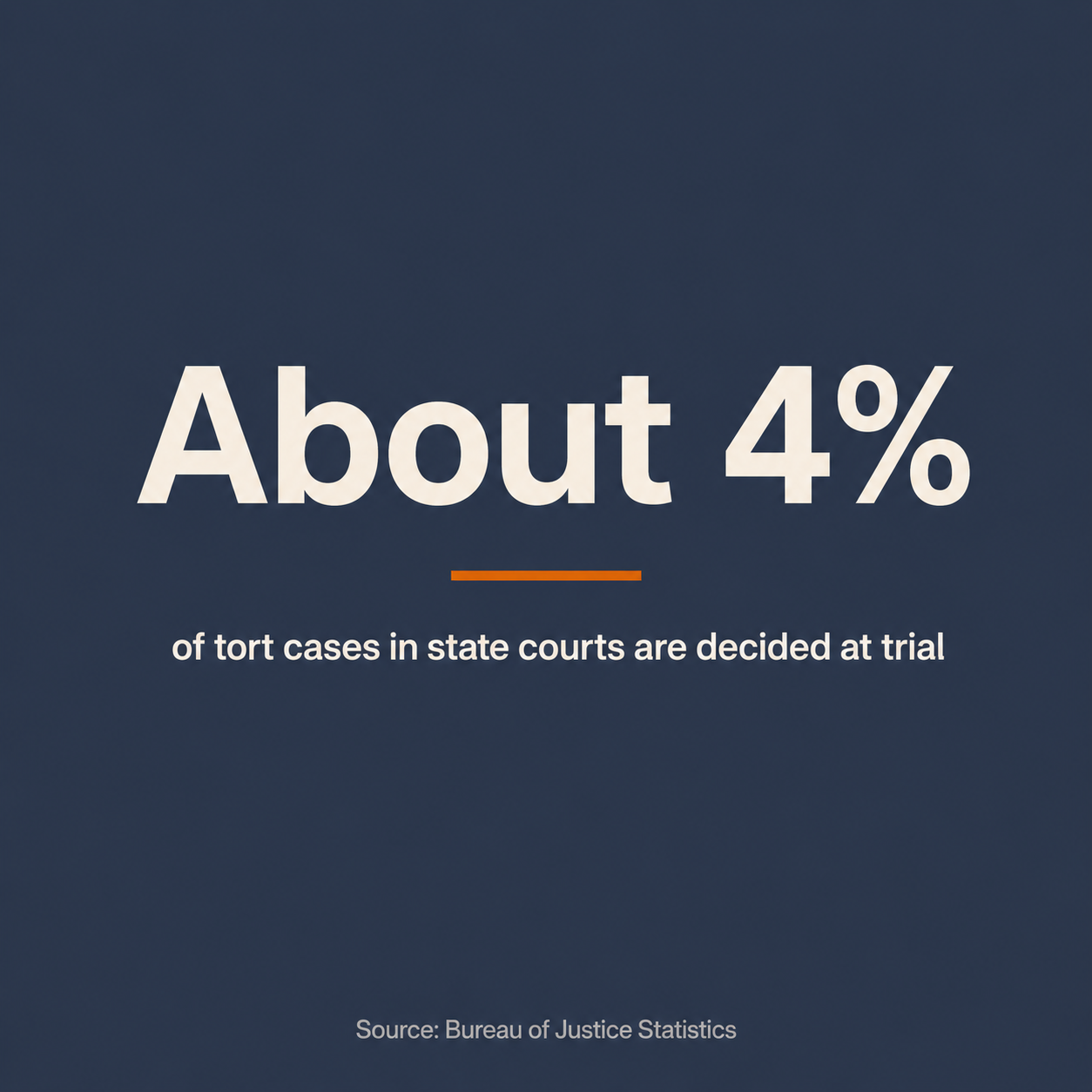
Most personal injury cases settle. Bureau of Justice Statistics data show that trials account for roughly 3% to 4% of tort case dispositions in state courts. So why does a trial record matter if your case will probably never see a jury?
Because in our experience, settlement negotiations are shaped by what the other side believes will happen if negotiations fail. An insurance company evaluating a demand from a firm with documented jury verdicts prices in the risk of a trial. A demand from a firm that has not tried a case in years carries no such risk. Trial capability is what gives a settlement demand its weight, even in the majority of cases that resolve without one.
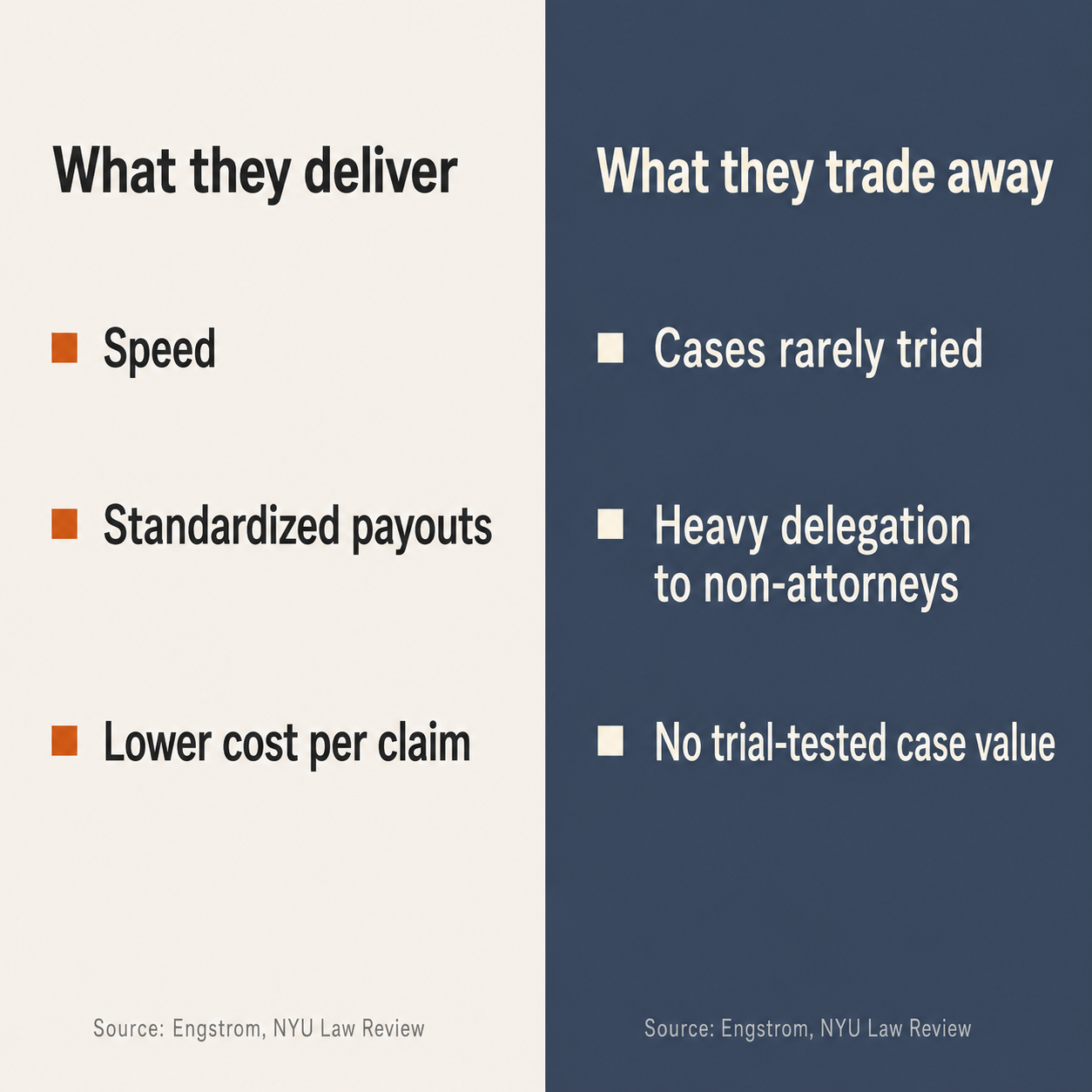
There is also academic research on the alternative. Stanford Law professor Nora Freeman Engstrom has documented what she calls "settlement mills": high-volume injury practices built on heavy advertising, substantial delegation to non-attorneys, and fast resolution of claims, usually without ever filing suit. Her findings cut both ways. These firms deliver speed and standardized payouts for routine claims. But cases are rarely tried, and clients may never learn what their case was actually worth to a defendant facing a credible trial threat.
For a minor claim, a fast standardized settlement may be a reasonable trade. For a catastrophic injury, a trucking accident with a corporate defendant, or a wrongful death, it usually is not. The more severe the injury and the more disputed the liability, the more trial capability should drive your decision.
We built our practice on the opposite model. We're not a billboard law firm. We rely on results. In June 2024, a federal jury in the Eastern District of New York returned a $4.2 million verdict in a negligence case Andy Goldwasser tried, finding the United States Twirling Association 88% responsible for the harm to a minor athlete in its care and the chaperone 12% responsible. The case is Doe 1 v. United States Twirling Association, Inc., No. 2:22-cv-05399 (E.D.N.Y.). Our personal injury practice page lists our other results, including a $5.8 million product liability verdict. We take on a limited number of serious cases and commit fully to each one, because that is what it takes to be genuinely ready for court.
Who Will Actually Handle Your Case?
Ohio's own ethics rules point to this question. When lawyers send targeted mail after an accident, Rule 7.3 of the Ohio Rules of Professional Conduct requires them to include an "Understanding Your Rights" disclosure that tells recipients to ask two questions: Who will handle your case? If the case goes to trial, who will be the trial attorney?
The Supreme Court of Ohio put those questions in a mandatory disclosure because the answers vary so much between firms. At high-volume practices, your day-to-day contact may be a case manager, and the lawyer whose name is on the building may never touch your file. Before you sign with any firm, get a direct answer about who handles the investigation, who negotiates with the insurer, and who stands up in court if it comes to that.
At C&G, the answer is simple: Andy Goldwasser evaluates every potential personal injury case himself and personally handles the cases we accept, supported by a team that has worked with him for decades. Clients have his direct number, and he typically answers it himself, including evenings and weekends.
What Questions Should You Ask in a Free Consultation?
Nearly every Cleveland injury firm offers a free consultation. Treat it as an interview where you are the one doing the hiring. The American Bar Association and the Supreme Court of Ohio both publish consumer guidance on working with a lawyer, and these questions draw directly from it:
Who will handle my case day to day, and who will be the trial attorney if the case goes to court?
How many cases like mine have you personally taken to a jury, and what were the results?
How selective are you about the cases you accept, and how many cases do you carry at once?
How does the contingency fee work, how are case costs advanced, and how are they repaid?
How often will I hear from you, and who do I call with questions?
What are the realistic outcomes for a case like mine?
A good lawyer answers these directly and in plain language. Evasive or vague answers, especially about fees or who handles the work, are your cue to keep looking.
How Do Contingency Fees Work in Ohio?
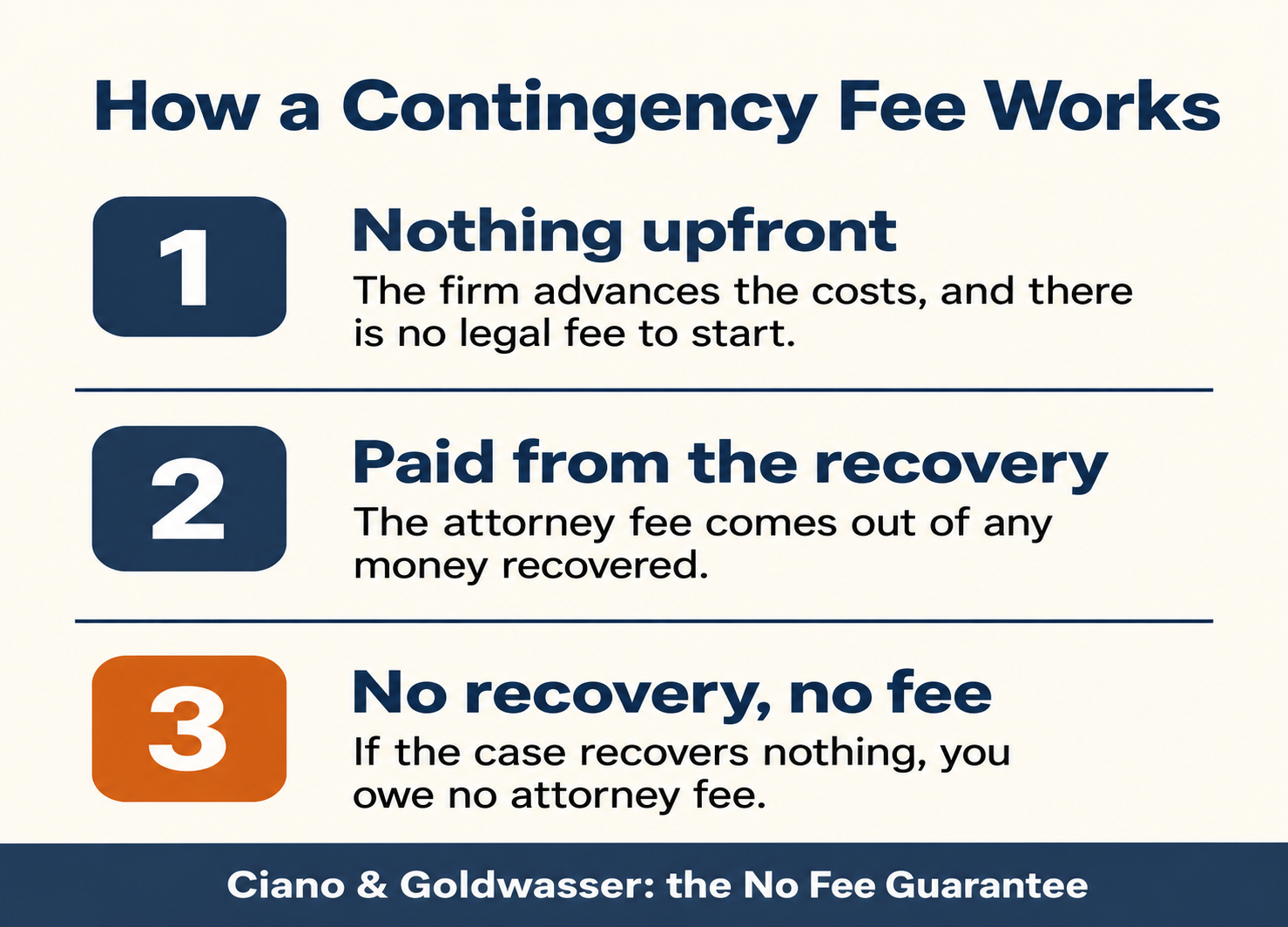
Personal injury representation in Ohio typically works on a contingency basis: no upfront legal fee, the firm advances the litigation costs, and the fee comes out of any recovery. If there is no recovery, there is no attorney fee.
Ohio law regulates these agreements closely. Rule 1.5(c) of the same Ohio Rules of Professional Conduct requires a contingent fee agreement to be in writing, signed by both lawyer and client, and to spell out:
The method used to calculate the fee, including the percentage that applies at settlement and if the case goes to court
Which litigation expenses will be deducted from the recovery
Whether expenses come out before or after the fee is calculated
Any expenses the client owes regardless of the outcome
At the end of the case, the rule also requires a signed closing statement showing exactly how the fee and every deduction were calculated. Read the agreement like a contract, not a brochure, and ask about anything unclear before signing. A firm that hesitates to explain its own fee agreement is showing you how it will communicate for the life of your case.
We handle every personal injury and wrongful death case at C&G on a contingency basis with our No Fee Guarantee: no upfront costs, and no attorney fee unless we win or settle your case.
Red Flags When Hiring a Personal Injury Lawyer
Ohio's professional conduct rules also define what lawyers may not do, and violations of the spirit of these rules are reliable warning signs:
Guaranteed outcomes. Rule 7.1 prohibits false or misleading communications, and even truthful case results can be misleading if they create unjustified expectations. No honest lawyer promises a specific result or dollar figure.
Unsolicited direct contact. Rule 7.3 bars in-person or live telephone solicitation of accident victims for the lawyer's financial gain. A lawyer or "runner" who shows up in person or calls you uninvited after a crash is violating the rules before you have even hired them.
Pressure to sign immediately. A strong case will still be strong tomorrow. Urgency tactics serve the firm, not you.
Vague fee answers. Rule 1.5(c) requires written specificity. A lawyer who cannot explain the fee clearly in conversation will not get clearer once you have signed.
How We Approach Personal Injury Cases at Ciano & Goldwasser
We are a boutique Cleveland litigation firm, small by design, with a personal injury practice led by Andy Goldwasser for more than 25 years. We keep a selective caseload so every case gets full commitment, we have no billable hour requirements, and we have the resources to go up against any defendant, no matter how complicated the case. Many of our cases come from referrals by other attorneys, judges, and former clients, which we consider the most meaningful credential a firm can hold.
If you or a family member has suffered a serious injury in Cleveland or anywhere in Northern Ohio, we offer a free, confidential consultation with no obligation. Andy personally evaluates every potential case. Call us at (216) 658-9900 or reach out through our contact page to talk through your situation and your options.