

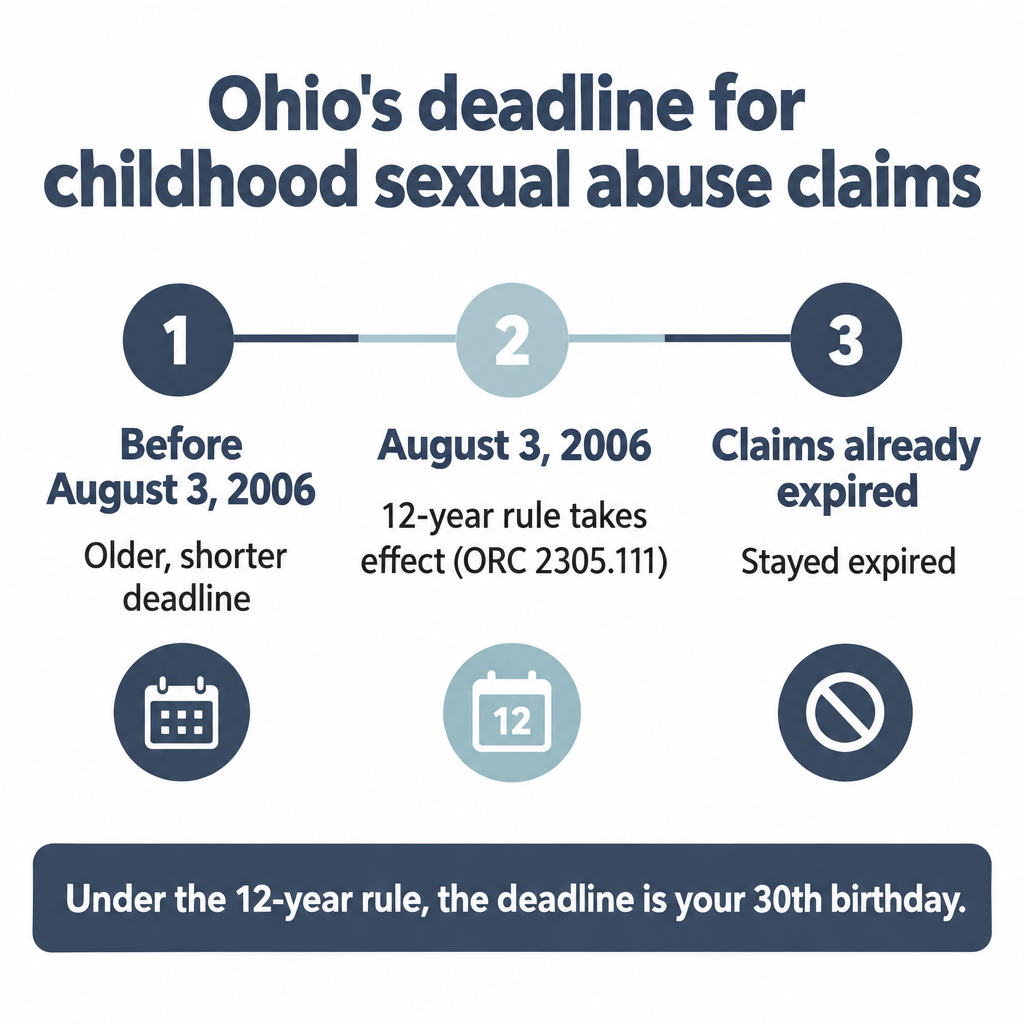
Under current Ohio law, most civil claims for childhood sexual abuse that happened decades ago have already expired. Ohio gives survivors until age 30 to sue. For most survivors who turned 18 before 2004, the claim expired even sooner, under an older and shorter deadline.
Some survivors past the deadline may still be able to sue. A federal law sets no deadline when the abuse involved certain federal crimes, such as sex trafficking or child pornography. Separately, Ohio lawmakers are drafting a bill that, according to reporting by WCPO, would give survivors a limited period to file claims from decades ago. A different bill already pending in the Ohio House would lengthen the deadline but, as written, would not bring back expired claims. As of November 2026, neither bill is law.
I'm a personal injury attorney at Ciano & Goldwasser, LLP with a focus on sex abuse cases. I also serve on the Board of Directors of the Cleveland Rape Crisis Center.
What options are left for abuse that happened decades ago?
Whether an option can still help you depends mostly on when you turned 18, because most survivors who turned 18 before 2004 lost their Ohio claims under the old deadline. The last column answers for those survivors.
| Option | Who it can help | Can it help if you turned 18 before 2004? |
|---|---|---|
| Filing before your 30th birthday | Survivors who are still under 30 | Usually not. Anyone who turned 18 before 2004 is past 30, and for most of them the old deadline has also passed. |
| Fraudulent concealment | Survivors abused on or after August 3, 2006, when the abuser or the organization being sued hid the facts the claim is based on | No. Abuse of someone who turned 18 before 2004 happened before August 3, 2006. |
| Claim against the organization | Survivors abused by someone connected to a school, church, camp or other organization | Usually not. The same deadline applies. |
| Federal claim under 18 U.S.C. 2255 | Survivors whose abuse as a minor involved certain federal crimes | Possibly, depending on the facts. |
| A limited period to file, in the proposed Ohio bill | Survivors whose deadlines have passed, according to WCPO | Not yet. It might, if the bill passes with a window that covers older cases. |
What is the statute of limitations for childhood sexual abuse in Ohio?
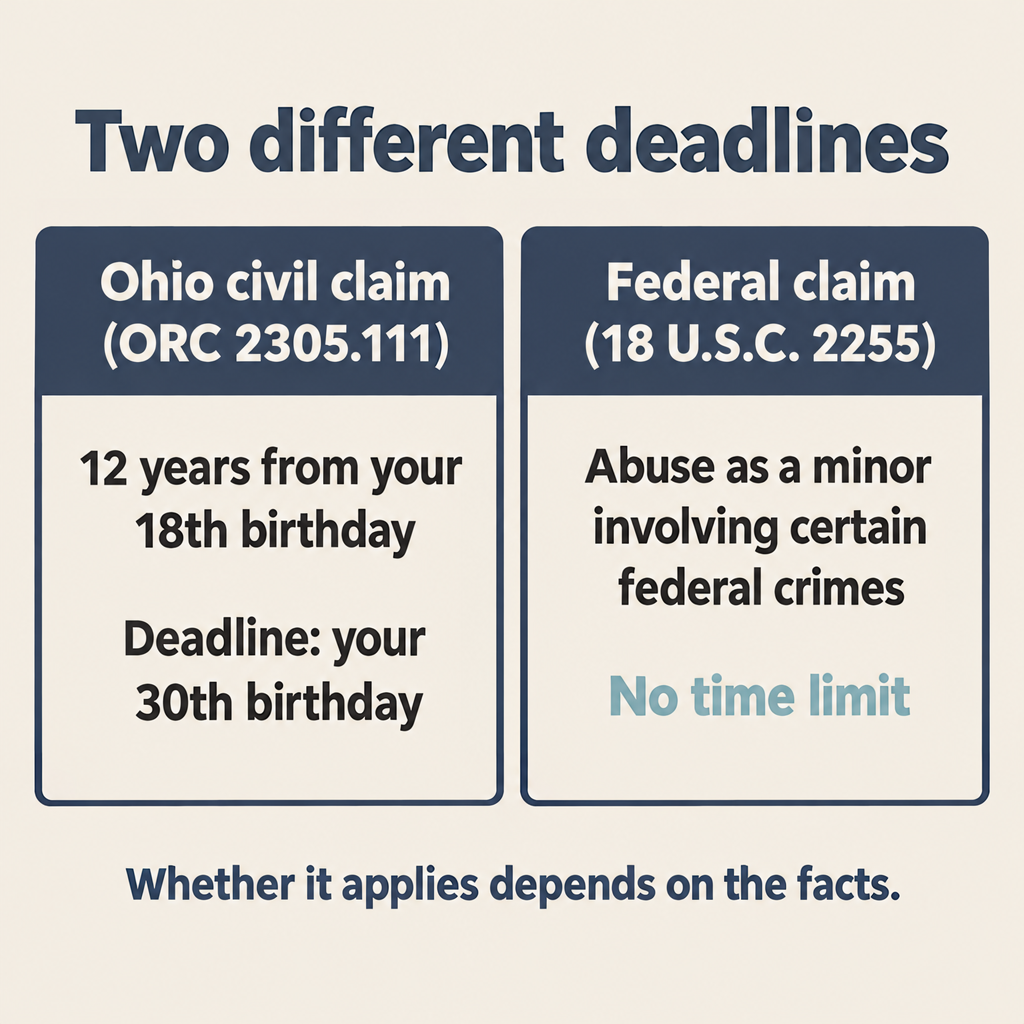
Ohio Revised Code 2305.111 sets the deadline at 12 years after the survivor's 18th birthday. It covers these kinds of abuse of a child under 18:
Rape and sexual battery, in every case.
Other sexual contact, only in situations the statute lists, such as when the abuser was the child's parent or guardian, a teacher or coach at the child's school or on the child's team, the leader of the child's scout troop, or a clergy member of the child's congregation. Outside those situations, a different and much shorter deadline may apply.
A civil claim does not depend on a criminal case. The person who abused you does not need to have been charged or convicted for you to sue, as we explain in our article on what kind of attorney handles sexual abuse cases.
If you are past 30, you are far from alone. Many survivors do not tell anyone for years: CHILD USA summarizes research finding that survivors who disclose childhood sexual abuse wait about 20 years on average. Chris Graham, an Ohio survivor, told 10TV that he had until he was 30 to file and came forward at 38.
Why did most survivors who turned 18 before 2004 lose their claims sooner?
Most survivors who turned 18 before 2004 lost their claims under Ohio's old deadline, before the 12-year rule existed. The 12-year rule took effect on August 3, 2006, and the old deadline was much shorter. For most people who turned 18 before 2004, it had already passed by that date. Anyone who is 41 or older today turned 18 before 2004.
The new rule did not bring those claims back. In Watkins v. Department of Youth Services, the Ohio Supreme Court held that the 12-year rule applies to older abuse, but only to "claims for which the former statute of limitations had not expired" when it took effect. A claim that had expired before August 3, 2006 stayed expired.
The court did recognize a possible exception. In some situations, such as when memories of the abuse were repressed, the law may treat a claim as starting later than the 18th birthday, so that claim may not have expired.
The 2006 bill originally included a one-year window to revive expired claims, but lawmakers removed it before the final vote.
Does the deadline apply to claims against a school, church or organization?
Ohio's age-30 deadline applies to claims against a school, church, camp or other organization, as well as to claims against the abuser. The statute covers "any claim resulting from childhood sexual abuse." In Watkins, the Ohio Supreme Court applied the same deadline to claims against the Ohio Department of Youth Services, a state agency.
A claim against the organization matters most when the abuser has died or has no money to pay what a court awards, because the organization that employed or supervised the abuser may still exist. A lawsuit against an organization that failed to protect a child can include claims for:
Negligence
Negligent hiring and supervision
Assault and battery
ORC 2307.60, which allows a civil lawsuit for injury caused by a criminal act
Title IX, the federal law that prohibits sex discrimination in education, in cases involving schools
Our guide to sexual assault victims' rights in Ohio explains how civil claims against institutions work.
What if the abuser or the organization hid what happened?
Ohio law pauses the deadline when the person or organization being sued fraudulently hid the facts the claim is based on. The statute says that in that situation the deadline "is tolled until the time when the plaintiff discovers or in the exercise of due diligence should have discovered those facts." That means the 12 years do not run while the facts are hidden, and they start running once the survivor learns them or reasonably could have.
This rule applies only to abuse that happened on or after August 3, 2006, so it does not help most survivors abused decades ago.
Realizing what happened later, on your own, is not enough to pause the deadline under this rule. The rule requires that the defendant hid the facts.
Are there sexual abuse claims with no deadline at all?
A federal law, 18 U.S.C. 2255, has no filing deadline for survivors whose abuse as a minor involved certain federal crimes. Those crimes include sex trafficking, child pornography, taking a child across state lines for sexual activity, and others the statute lists. Since Congress changed the law on September 16, 2022, the statute has said, "There shall be no time limit for the filing of a complaint commencing an action under this section."
Not every abuse case involves one of the listed crimes, and the 2022 change did not apply to federal claims that had already expired before it. Whether this law covers an older case depends on its facts.
What if the abuser has died?
If the abuser has died, a claim against the money and property they left behind, called their estate, generally must be made to the person handling the estate within six months of the death. Under ORC 2117.06, a claim not presented in time "shall be forever barred as to all parties," subject to limited exceptions. For survivors whose abuser died years ago, that likely ends the claim against the estate.
A claim against the organization connected to the abuse is a separate claim against a separate party, so the abuser's death does not by itself end it.
What if I was an adult when the abuse happened?
For sexual abuse that happened after age 18, Ohio's deadline for an assault or battery claim is one year. Senate Bill 421, which has passed the Ohio Senate but is not law, would give survivors five years to sue the person who committed the abuse.
Is Ohio changing the law on sexual abuse deadlines?
Ohio lawmakers are drafting a bill that could let survivors whose deadlines have passed file a lawsuit. In September 2026, Sen. Bill Blessing (R-Colerain Township) and Rep. Rachel Baker (D-Cincinnati) announced plans for a bill to eliminate the civil deadline for childhood sexual abuse claims against both abusers and institutions, Fox19 reported. "I see no reason why somebody should be off the hook for something like this," Blessing said.
Ending the deadline would not by itself bring back claims that have already expired, so survivors abused decades ago would need a lookback window. WCPO reported that the bill would include one: a temporary period in which survivors whose deadlines have already passed could file. WCPO did not report how long the window would last or who would qualify. As of November 8, 2026, the bill had not been introduced and had no bill number.
Sen. Blessing plans to introduce the bill this fall, in the short session lawmakers hold after the November election, according to Hoodline. If it stalls, he plans to introduce it again in early 2027. If the bill passes, its exact terms will decide who can file and when.
The proposal would also let prosecutors file criminal charges regardless of when the abuse happened. Under current law, Fox19 reports, criminal charges must be filed by the survivor's 43rd birthday. That criminal deadline does not extend the deadline to sue, which is still age 30.
What should I do now if I think it may be too late?
The most useful step is to find out where you stand, and you can start on your own before you talk to anyone:
Write down what you remember. Include approximate dates, places, the people involved, and any organization connected to the abuser, such as a school, church, team or camp.
Note two ages. Your age when the abuse happened and your age today help decide which deadline applies.
Gather what you have. Letters, messages, photos, records and the names of anyone you told can all help.
Find out whether the abuser is alive and whether the organization still exists.
Have a lawyer review it before you assume it is too late. Whether one of these options applies depends on facts you may not realize are important. If you are comparing attorneys, our article on how to choose a sexual assault attorney in Ohio covers what to look for.
If you were abused in Ohio, whether a few years ago or decades ago, I would be glad to talk with you about what happened and what options you may have. A consultation with our firm is free and confidential, and it does not commit you to filing anything. If you decide to move forward, we handle sexual abuse cases on a contingency basis under our No Fee Guarantee: you pay no fee unless we win. You can reach our Beachwood office at (216) 658-9900, or read more about how we represent survivors of sexual assault.
